April 22, 2026


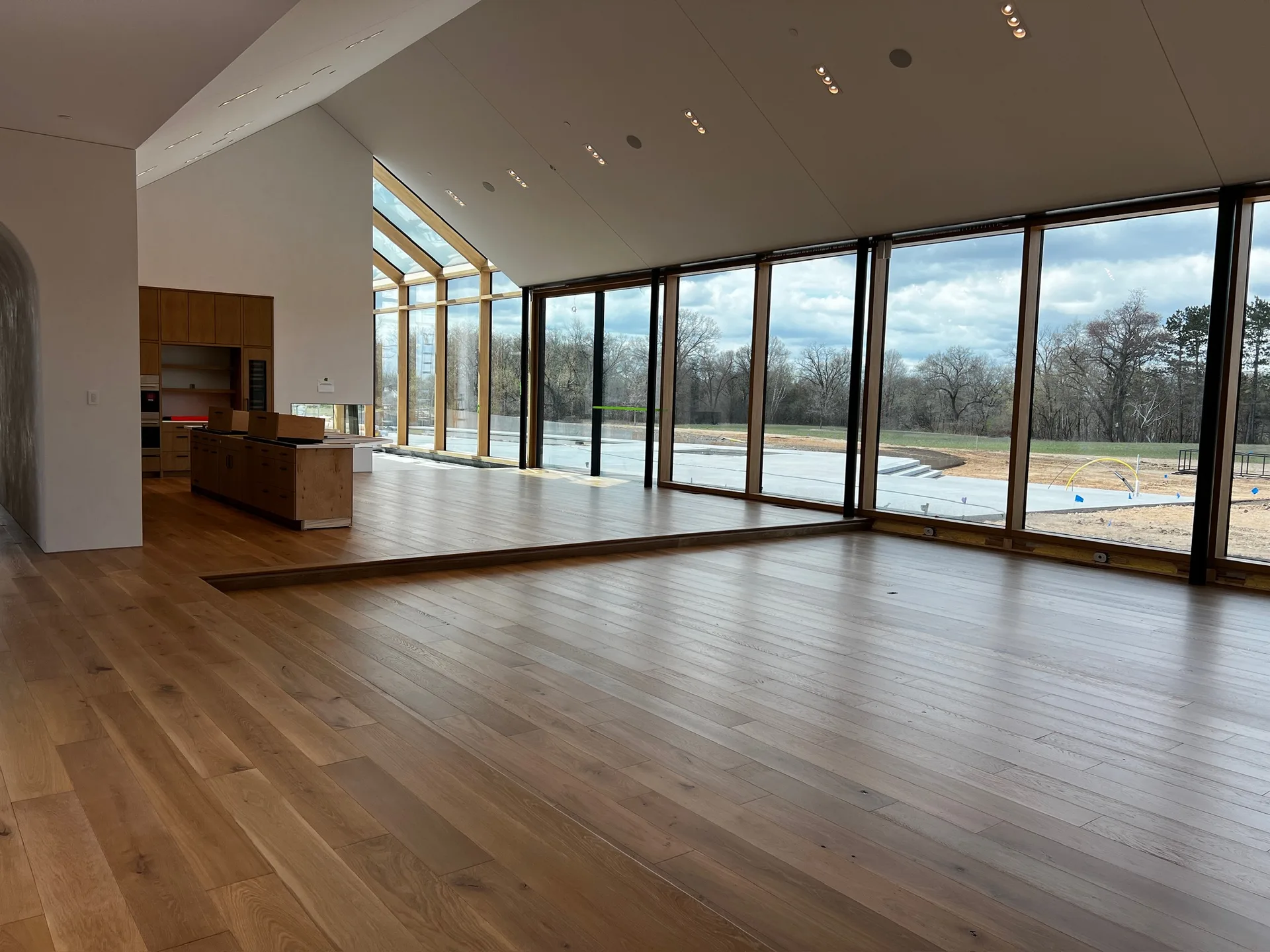
Wide-plank floors have been one of the biggest shifts in residential hardwood over the last ten years. Where a three-and-a-quarter inch board was standard for decades, we're now regularly installing planks seven, eight, even ten inches wide. The look is excellent. The physics gets more complicated.
A wider plank shows more of each tree's grain in one continuous piece. You get long character marks, knots, and movement in the wood that get chopped up on narrower strips. Fewer seams mean less visual noise across the room, which is why wide plank reads as calmer and more modern even when the species and stain are the same.
It also reads as more expensive, because it usually is. Wider boards require larger logs milled more carefully with more waste, so raw material cost goes up.
Wood expands and contracts across its width, not along its length. A three-inch board shrinking a percent loses a tiny fraction of an inch. An eight-inch board shrinking the same percent loses more than twice that, and the gap between boards is noticeably bigger. Wide planks amplify every humidity swing the house goes through.
That's why humidity control matters more for wide plank than for narrow strip. Without a whole-house humidifier holding winter levels in the 35 to 45 percent range, wide plank floors in Minnesota will show gaps every January that are hard to miss.
For planks over six inches, we almost always recommend engineered construction over solid. Engineered hardwood has a plywood or hardwood substrate with a real hardwood wear layer on top, and the cross-grain construction resists seasonal movement much better than a solid board does. You get the same look with far less headache.
Solid wide plank can work, but the site has to be right. Slab-on-grade installs, radiant heat, or houses with inconsistent humidity are not friendly environments for solid wide plank.
Narrow strip flooring forgives a lot. Wide plank does not. A subfloor that dips or heaves even a little shows up as hollow spots or boards that rock under weight. Before we lay wide plank we check the subfloor against a straight edge and shim or sand anywhere it varies more than an eighth of an inch over ten feet. That prep time is often the biggest variable in a wide plank install.
In custom homes around the Twin Cities, 6-inch and 7-inch are the workhorses. Wider than 8 inches is a statement choice, usually in rift and quartered white oak, and requires more finicky conditions to stay stable. Ten-inch-plus plank exists and looks stunning, but we sit down with customers and walk through the maintenance reality before committing to it.
Wide plank is a beautiful floor when the conditions support it. Humidity control and subfloor prep aren't optional. If you're willing to run a humidifier year-round and pick an engineered construction sized for your rooms, you get a floor that looks incredible and performs well. If humidity control isn't in the plan, stick with narrower boards and save yourself the callbacks.
Articles & Insights