April 22, 2026

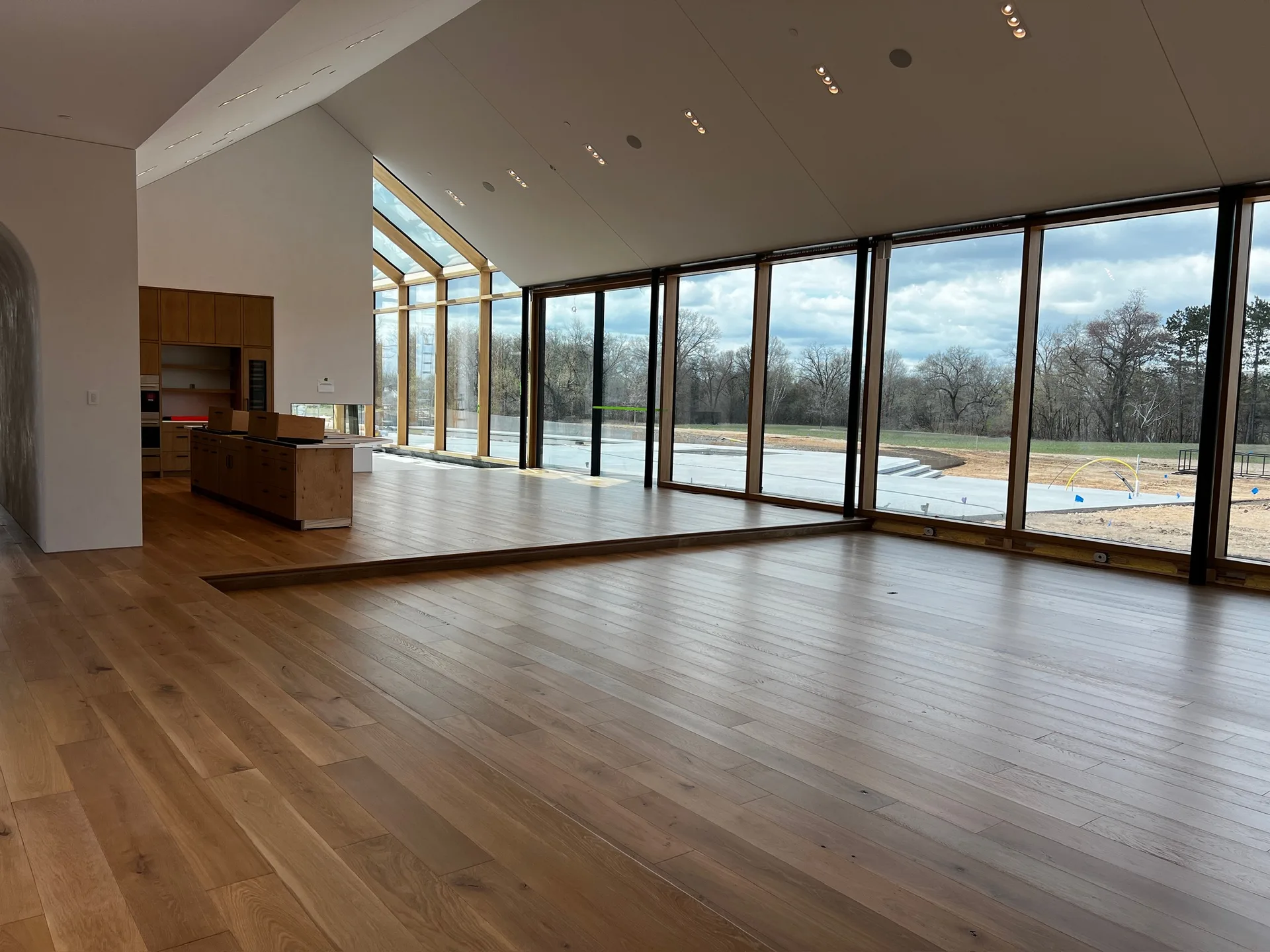
On most custom home projects we work on, one of the first questions we talk through with the builder is whether to go prefinished or site-finished. The boards come from the same trees either way. What changes is where and when the finish goes on, and the implications of that choice are bigger than most homeowners realize.
Prefinished hardwood comes out of the factory stained, sealed, and topcoated before it ever arrives at the job site. You nail it down, trim it, and move furniture in the same day. The finish is cured under UV light and is typically harder than anything we can apply on site.
Site-finished means raw boards go down, we sand them flat as a unit, apply stain if any, and roll on two or three coats of finish over several days. The floor has to sit untouched for a day or more between steps, and you can't really live on it for about a week.
Every prefinished board has a small bevel machined along its edge, sometimes called a microbevel. It's there because the finish is on each board individually, and the bevel keeps the edges from showing any height mismatch. From a distance it looks fine. Up close, you can see every seam, and the bevels catch dust and crumbs.
A site-finished floor gets sanded flat after installation, which means no bevels and no visible seams between boards. It reads as one continuous surface. For a custom home with wide-plank floors and a clean design direction, that's usually the look people want.
Factory finishes are typically aluminum oxide or similar, cured under UV, and rated for thousands of hours of simulated wear. They outlast any job-site finish on paper. The trade-off is that when they do get damaged, you can't easily touch them up. Matching a factory finish on a single board is nearly impossible.
Job-site finishes (water-based poly, oil-modified, hard wax) are softer but refinishable in spots. A gouge in one plank can be sanded and recoated locally without redoing the whole floor. That matters over a twenty-year life cycle.
For a custom home with other trades still moving through the space, prefinished wins on timeline. Trim can be caulked and painted, appliances can come in, and the floor is ready the same day. A site-finished floor needs the space empty of trades for five to seven days minimum. On a tight schedule that's a real cost.
The flip side is that a site-finished floor is installed first, then trim goes on top of it. That gives a cleaner trim-to-floor interface without the gap that comes from scribing prefinished baseboard over a finished floor. Painters like it. So do the homeowners who notice those details.
With prefinished you pick from what the manufacturer offers. The palette is wide but finite. Site-finished opens up custom stain work. We can match an existing floor, blend two colors, or produce something the customer has in a magazine photo but isn't commercially available. On high-end custom builds that flexibility is often the deciding factor.
For production builds and remodels where price and schedule rule, prefinished makes sense. The install is fast and the warranty is good. For custom homes where the floor is a visible design feature and the stain color matters, site-finished is almost always the right call. Both have their place and we do a lot of each.
Articles & Insights